Recently, the research group led by Professor Hu Xingjun from the School of Automotive Engineering, Jilin University, has achieved major breakthroughs in the research on nanoscale droplet wettability. The relevant research paper, titled Volume Dependence of Contact Angle in Nanodroplets: Interface Layering Contributions beyond the Standard Line Tension, was published in Journal of Chemical Theory and Computation — an authoritative journal in computational chemistry (CAS Zone 1 Top Journal, JCR Q1, Impact Factor = 5.5) and selected as the cover article of the current issue.
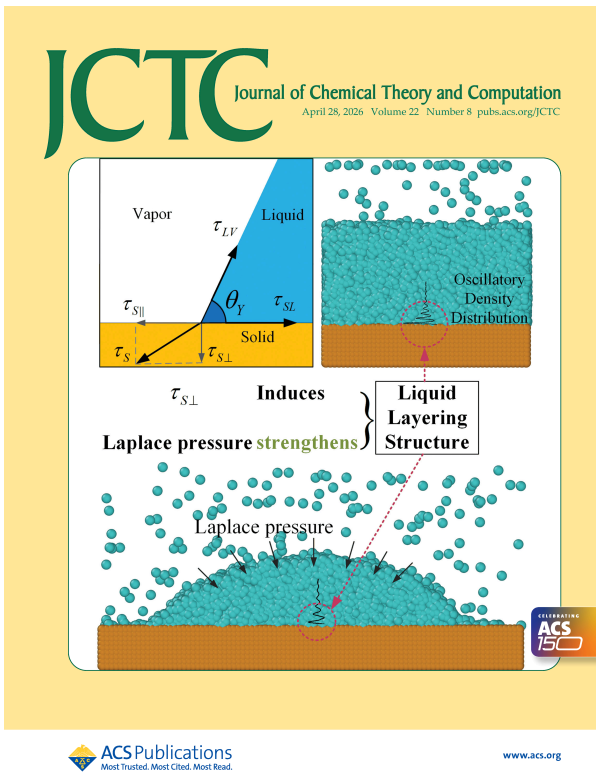
Wettability of liquid droplets plays a pivotal role in numerous applications, ranging from macroscopic scenarios such as raindrops impinging on automotive surfaces to microscopic fields including microflow control and boiling nucleation. Accordingly, the cross-scale continuity and accuracy of the volume dependence of contact angles bear critical scientific significance and engineering value. The contact angle of nanodroplets varies with droplet volume, a volume-dependent characteristic conventionally attributed to standard line tension. Nevertheless, the layered molecular structure of liquid near the solid-liquid interface introduces additional volume-dependent contributions, which trigger systematic errors in traditional wettability analysis and standard line tension measurement.
To address this issue, the research team derived a correlation function relating droplet contact angle to contact curvature based on Gibbs thermodynamic theory. Via molecular dynamics simulations, the team systematically revealed the intrinsic mechanism through which liquid layered structures govern the volume dependence of contact angles: liquid layering reshapes the density distribution at the solid-liquid interface and modulates interfacial properties such as liquid adsorption, thereby altering contact angles. This effect exhibits a first-order relationship with the contact curvature of droplets, with a contribution magnitude comparable to that of standard line tension. The study further clarified the synergistic regulatory effects of normal solid capillary force and Laplace pressure on liquid layered structures.
This discovery not only deepens fundamental scientific understanding of nanoscale wetting phenomena but also delivers vital theoretical support for multiple engineering disciplines. It lays a theoretical foundation for precision design of microfluidic chips and nanofabrication, facilitates performance optimization of interfacial flows in automotive fuel cells, and is expected to drive technological breakthroughs in micro/nano anti-icing surfaces for unmanned aerial vehicles, flying cars and other aircraft.
The first author of this paper is Wan Qinlin, a doctoral candidate at the School of Automotive Engineering, Jilin University. Co-corresponding authors are Professor Hu Xingjun and Professor Wang Jingyu. During the research, the team received meticulous guidance from Professor Jin Ying’ai of the School of Automotive Engineering and Professor Firoz Alam from RMIT University. Dr. Li Li, Associate Research Fellow, and Dr. Yu Wentao from the International Joint Research Center for Nanomanipulation and Nanomanufacturing, Changchun University of Science and Technology, provided substantial support to this work. The research was funded by the Science and Technology Development Program of Jilin Province (Grant No. 20220301013GX).
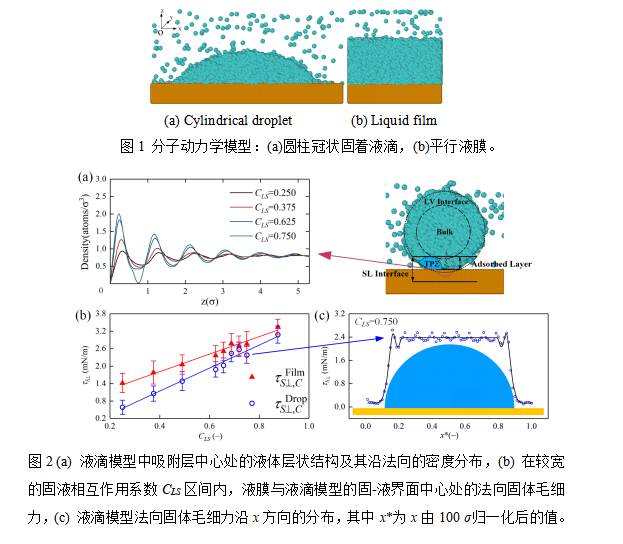
Figure Captions:
Figure 1 Molecular dynamics simulation models: (a) Cylindrical sessile droplet; (b) Parallel liquid film.
Figure 2 (a) Liquid layered structure and its normal density distribution at the center of the adsorbed layer in the droplet model; (b) Normal solid capillary force at the central solid-liquid interface of liquid film and droplet models across a wide range of solid-liquid interaction coefficient
Cls;
c) Distribution of normal solid capillary force along the x-direction in the droplet model, wherex∗ denotes the x-coordinate normalized by 100 atomic units (a).


 Official WeChat
 Official weibo